The Aslan Signal Engine is a multi-layered trading framework built to help traders identify opportunity, structure trades, and manage risk with discipline. Rather than relying on a single signal type, it combines multiple signal types, volatility analysis, dynamic support and resistance, integrated trade management and much mre into one cohesive system.
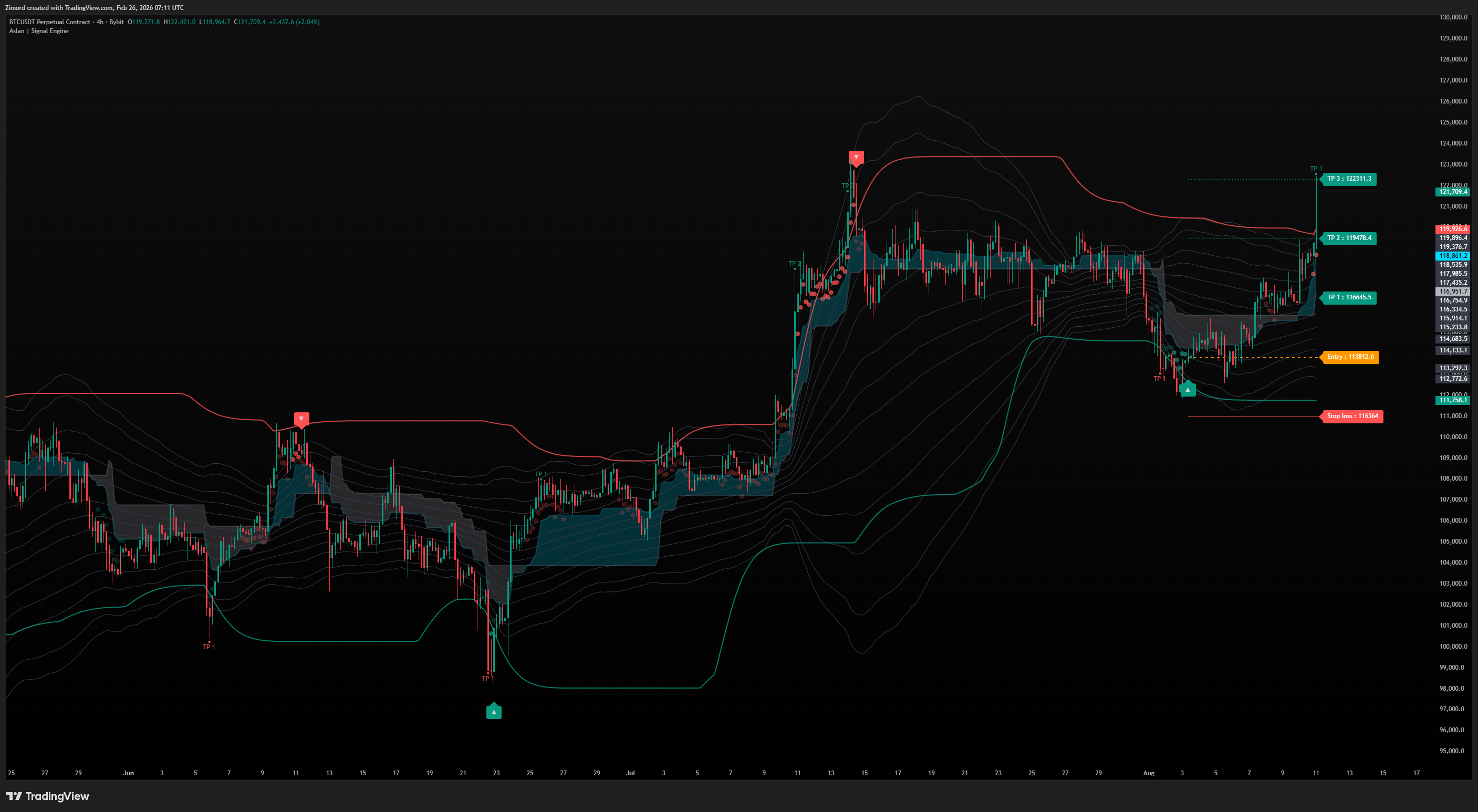
Trend Following and Contrarian.
Contrarian signals are based on mean-reversion logic: after a large price movement, they anticipate a pullback, betting on the exhaustion of momentum and a reversion to the mean.
Trend-following signals, on the other hand, are based on the premise that early momentum is likely to persist - Waiting for a confirmed move before entering a trade, betting on the move to continue after this early momentum
Both methodologies have different risk profiles - contrarian seeks to capitalize on reversals, typically achieving excellent risk reward (Almost no drawdown on winning trades) but lower winrate. 
Trend following signals seek sustained directional moves, with a lower risk reward and more drawdown but higher win rate. 
Both models have limitations when used in isolation. Trend-following signals tend to lag, often confirming moves only after the trend has begun to lose momentum. Conversely, contrarian signals can trigger too easily, anticipating reversals before the first trend has fully played out.
By using these two approaches in confluence, we can harness their strengths - mitigating individual weaknesses and developing a more robust, profitable trading system. A straightforward yet effective strategy is first waiting for a contrarian signal indicating overbought or oversold conditions. Following this, a trend following signal on a lower time frame is used to confirm the start of a new trend, providing a higher-probability entry point than one signal type alone.
Contrarian signals tend to perform best in consolidating or balanced markets, where price oscillates within a defined range and mean-reversion strategies have higher probability. In contrast, trend-following signals are more effective in trending or imbalanced markets, where momentum is strong in one direction.